Wednesday, 19 July 2017

Working Principle of Water Heaters


Working Principle of Water Heaters

Almost everyone uses a water heater in day to day life. But how many of us have the exact idea of how it works and how the cold water is converted to hot water? What are the elements that are used for this process?

Introduction          

      We use hot water for various purposes in daily life. For domestic purposes like cooking, bathing, etc. or for industrial purposes, we require hot water. Water heating is a thermodynamic process where a source of energy is used to heat water. The energy source may be natural gas, liquefied petroleum gas, propane, oil, or electricity. Now-a-days solar energy is also used for the water heating process.

Parts of an Electric Water Heater

      For the process of heating water we need three main components. They are:
      Dip Tube (Inlet tube): Cold water enters the tank through this tube.
      Outlet Tube: Hot water goes out of the tank through this tube.
      Heating elementThis element helps in heating the cold water.
      There are various other parts used in a water heater.
      Steel tank: This unit holds the water. The steel tank has to be constructed in such a way that it should be able to withstand the pressure of water inside the tank.
      Temperature and Pressure relief valve: These valves are specially placed for safety purposes. This valve prevents the heater from explosion during abnormal conditions like high pressure and temperature. It can be mounted either at the top of the tank or at the sides of the tank.
      Drain Valve: The drain valve is used for cleaning and maintenance.
      Thermostat: A thermostat is generally used to control or maintain the temperature within the tank.
      Anticorrosion Anode Rod: This rod, also known as a sacrificial anode rod, aids in keeping the steel tank free from corrosion. This rod is made up of magnesium, which attracts corrosive elements and thus prevents the tank from corroding. This rod can be replaced when it becomes eroded.
      Apart from this there is insulation provided that surrounds the steel tank of the heater.
      The steel tank is internally coated with an epoxy or glass lining to prevent corrosion (in addition to anticorrosion rod).
Electric water heater-2

How Electric Water Heaters Work

      Generally electric water heaters have two heating elements each wired with a thermostat. Both the heating elements do not function simultaneously. First the top heating element functions until the upper tank is hot and then the function is transferred to the bottom heating element, which has its own thermostat. Usually the water in the upper tank is heated from 120-140 F before the control is transferred to the lower heating element.
      But some heaters have only one heating element which makes maintenance easier. In case of heating element failure it can be detected and replaced easily when there is only one heating element.
      When the hot water is consumed, once again cold water enters through the dip tube and the process is repeated.
Electric water Heater

Gas Water heater

      The gas water heater is very similar in construction to the electric water heater. Here instead of electric supply, there is a gas supply. Instead of heating elements, there is a burner and burner control. The burner is used for heating the water in gas water heaters.
      The working principle is based on law of convection. The cold water always remains at the bottom as it is denser than the hot water. As the water gets heated up it expands and moves to the top of the tank. If you look at the construction, we can see that the outlet tube is always smaller than the dip tube (inlet tube). This is to ensure that cold water is not supplied and only hot water is supplied through the tube. There is also a flue exhaust in gas type water heater which acts as heat exchanger as well as is used in exhausting the combustion gasses.
Electric and Gas water Heater


Tuesday, 18 July 2017

Projectile Motion What is a Projectile? What is Projectile Motion and what are different equations used in projectile motion?


Projectile Motion

What is a Projectile? What is Projectile Motion and what are different equations used in projectile motion?

A particle moving under the combined effect of vertical and horizontal forces, is called a projectile. The following terms are commonly used in projectiles:
1. Trajectory. It is the path traced by a projectile in the space.
2. Velocity of projection. It is the velocity with which a projectile is projected.
3. Angle of projection. It is the angle,with thehorizontal,at which the projectile is projected.
4. Time of flight. It is the total time taken by a projectile, to reach maximum height and to return back to the ground.
5. Range. It is the distance between the point of projection and the point where the projectile strikes the ground.


Monday, 17 July 2017

Types of Flat Belt Drives

Types of Flat Belt Drives
                                       
The power from one pulley to another may be transmitted by any of the following types of belt drives:

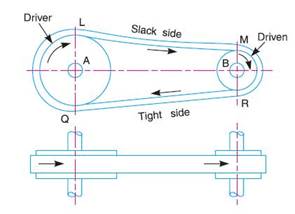
1. Open belt drive. The open belt drive, as shown in Fig. 11.3, is used with shaftsarranged parallel and rotating in the same direction. In this case, the driver A pulls the belt from one side (i.e. lower side RQ) and delivers it to the other side (i.e. upper side LM). Thus the tension in the lower side belt will be more than that in the upper side belt.The lower side belt (because of more tension) is known as tight side whereas the upper side belt (because of less tension) is known as slack side, as shown in Fig.


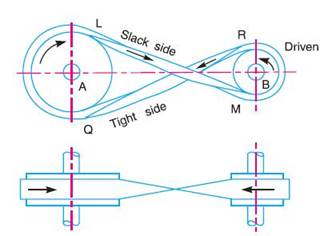
2. Crossed or twist belt drive. The crossed or twist belt drive, as shown in Fig. 11.4, isused with shafts arranged parallel and rotating in the opposite directions. In this case, the driver pulls the belt from one side (i.eRQ) and delivers it to the other side (i.eLM). Thus the tension in the belt RQ will be more than that in the belt LM. The belt RQ(because of more tension) is known as tight side, whereas the belt LM (because of less tension) is known as slack side, as shown in Fig.

A little consideration will show that at a point where the belt crosses, it rubs against each other and there will be excessive wear and tear. In order to avoid this, the shafts should be placed at a maximum distance of 20 b, where b is the width of belt and the speed of the belt should be less than 15 m/s.


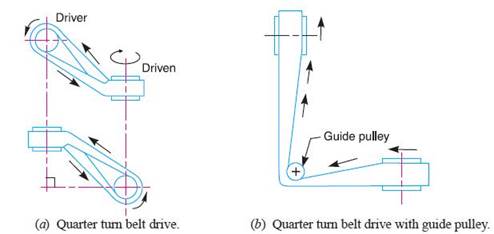
3. Quarter turn belt drive. The quarter turn belt drive also known as right angle beltdrive, as shown in Fig. (a), is used with shafts arranged at right angles and rotating in one definite direction. In order to prevent the belt from leaving the pulley, the width of the face of the pulley should be greater or equal to 1.4 b, where b is the width of belt. In case the pulleys cannot be arranged, as shown in Fig. (a), or when the reversible is desired, then a quarter turn belt drive with guide pulley, as shown in Fig. (b), may be used.


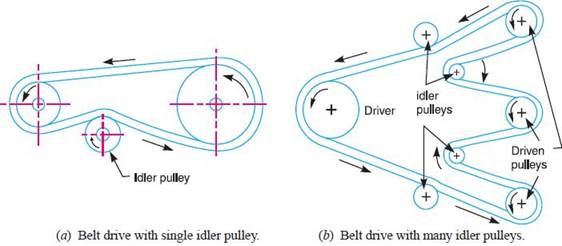
4. Belt drive with idler pulleys. A belt drive with an idler pulley, as shown in Fig. (a), isused with shafts arranged parallel and when an open belt drive cannot be used due to small angle of contact on the smaller pulley. This type of drive is provided to obtain high velocity ratio and when the required belt tension cannot be obtained by other means.

When it is desired to transmit motion from one shaft to several shafts, all arranged in parallel, a belt drive with many idler pulleys, as shown in Fig. (b), may be employed.


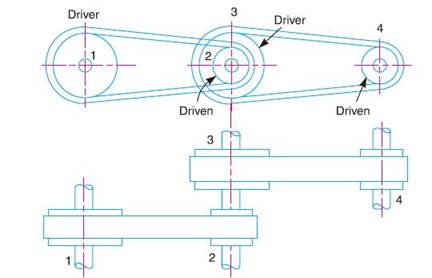
5. Compound belt drive. A compound belt drive, as shown in Fig., is used when power is transmitted from one shaft to another through a number of pulleys.


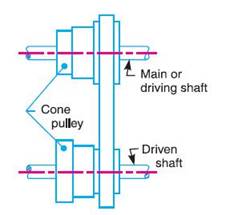
6. Stepped or cone pulley drive. A stepped or cone pulley drive, as shown in Fig, is usedfor changing the speed of the driven shaft while the main or driving shaft runs at constant speed. This is accomplished by shifting the belt from one part of the steps to the other.


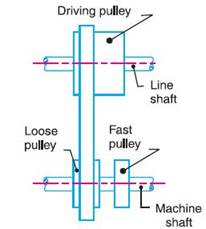
7. Fast and loose pulley drive. A fast and loose pulley drive, as shown in Fig., is usedwhen the driven or machine shaft is to be started or stopped when ever desired without interfering with the driving shaft. A pulley which is keyed to the machine shaft is called fast pulley and runs at the same speed as that of machine shaft. A loose pulley runs freely over the machine shaft and is incapable of transmitting any power. When the driven shaft is required to be stopped, the belt is pushed on to the loose pulley by means of sliding bar having belt forks.


Sunday, 16 July 2017

Governing of IC Engines

Governing of IC Engines

The process of providing any arrangement, which will keep the engine speed constant (according to the changing load conditions) is known as governing of I.C. engines. Though there are many methods for the governing of I.C. engines, yet the following are important :

1. Hit and miss governing. In this system of governing, whenever the engine starts running at higher speed (due to decreased load), some explosions are omitted or missed. This is done with the help of a centrifugal governor. This method of governing is widely used for I. C. engines of smaller capacity or gas engines.
2. Qualitative governing. In this system of governing, a control valve is fitted in the fuel delivery pipe, which controls the quantity of fuel to be mixed in the charge. The movement of control valve is regulated by the centrifugal governor through rack and pinion arrangement.
3. Quantitative governing. In this system ofgoverliing, the quality of charge (i.e. air-fuel ratio of the mixture) is kept constant. But the quantity of mixture supplied to the engine cylinder is varied by means of a throttle valve which is regulated by the centrifugal governor through rack and pinion arrangement.
4. Combination system of governing. In this system of governing, the qualitative and quantitative methods of governing are combined together.


Wednesday, 12 July 2017

Jigs vs Fixtures

Jigs vs Fixtures

                                                          
The terms “jig" and “fixture" are many times referred as the synonyms of each other, sometimes both the terms are used together as “jig fixture." Although, both jig and fixture are used in mass production process, functionally the two are different tools.

What is a Jig?

In simple terms, the jig is a tool that guides the cutting (or machining) tool. The most common type of jig is the drill jig, which guides the drill bit for creating holes at desired locations. Using drill jigs increases production rate drastically by eliminating the time spent using a square scriber, height gauge, centre punch, etc. The picture below shows the functionality of a simple drill jig:
Drill Jig
Like drill jigs, welding jigs and woodworking jigs are also used in industry quite extensively. Woodworking jigs are useful for creating intricate wooden profiles.

What is a Fixture?

The fixture is a tool which holds the workpiece with the machine bed precisely at the desired location. The fixture also reduces the nonproductive loading, unloading, and fixing time of the workpiece. For example, you need to use a milling machine for giving a chamfer at the corner of rectangular work pieces. You can use a vice to hold it in the desired position, but in that case every new work piece will take lots of time for fixing it. On the other hand if you can make a milling fixture like the one shown below and bolt the fixture to the milling machine bed, then you need not waste much time for fixing the work pieces every time:
Milling Fixture
You just place the workpiece and it will automatically aligned to the required angle, and straight away you run the machining operation, no need to measure the angle, and no need to be worried about the accuracy.

Conclusion

Both the jigs and the fixtures are used to reduce the nonproductive time of any mass production process. The principle of location or the 3-2-1 principleCAD tools (like ProE), and FEA tools (like ANSYS) are used for the design of the jigs as well the fixtures. The jig is used for guiding the cutting tool (like a drill bit), and for doing so, jigs have components like a bush, which comes in contact with the cutting tool. On the other hand, a fixture never comes in direct contact with the cutting tool. Fixtures assure the position and alignment of the work pieces for getting the required machining operation done.


Friday, 7 July 2017

What Is Thermal Equilibrium

What Is Thermal Equilibrium


When there are variations in temperature from point to point of an isolated system. the temperature at every point first changes with time. This rate of change decreases and eventually stops. When no further changes are observed, the system is said to be in thermal equilibrium.

Thursday, 6 July 2017

Hydraulic Turbines

Hydraulic Turbines


A hydraulic turbine is a machine which converts the hydraulic energy into mechanical energy. The hydraulic turbines are also known as water turbines. Following two types of hydraulic turbines are important.
1.     Impulse turbine
2.     Reaction turbine
In an impulse turbine, the total energy at the inlet of a turbine is only kinetic energy. The pressure of water both at entering and leaving the vanes is atmospheric. It is used for high head of water. A Pelton wheel is a tangential flow impulse turbine.
In a reaction turbine, the total energy at the inlet of a turbine is kinetic energy as well as pressure energy. It is used for low head of water. The Francis and Kaplan turbines are inward flow and axial flow reaction turbines respectively.

Tuesday, 4 July 2017

Buoyancy and buoyant force


Buoyancy and buoyant force

When a body is immersed wholly or partially in a liquid, it is lifted up by a force equal to the weight of liquid displaced by the body. This statement is known as Archimede's principle.

The tendency of a liquid to uplift an immersed body, because of the upward thrust of the liquid, is known as buoyancy. The force tending to lift up the body is called the force of buoyancy or buoyant force and it is equal to the weight of the liquid displaced. The point through which the buoyant force is supposed to act, is known as centre of buoyancy. It may be noted that
      If the force of buoyancy is more than the weight of the liquid displaced, then the body will float.
      If the force of buoyancy is less than the weight of the liquid displaced, then the body will sink down.


Sunday, 2 July 2017

Different Types of Energies or Head of a Liquid in Motion

Different Types of Energies or Head of a Liquid in Motion

Different Types of Energies or Head of a Liquid in Motion. The following are the three types of energies or head of flowing liquids:
  • 1. Potential energy or potential head. It is due to the position above some suitable datum line. It is denoted by z.
  • 2. Kinetic energy or kinetic (or velocity) head. It is due to the velocity of flowing liquid. Its value is given by v2/ 2g, where v is the velocity of flow and g is the acceleration due to gravity.
  • 3. Pressure energy or pressure head. It is due to the pressure of liquid. Its value is given by p/w, where p is the pressure in N / m2 and w is the weight density of the liquid in N / m3.

Note: The total energy or total head of a liquid particle in motion is given as follows :
Total energy, E = Potential energy + Kinetic energy + Pressure energy
and
  • Total head, H = Potential head + Kinetic head + Pressure head

Tuesday, 23 August 2016

What is Mechanical Engineering ?

What is Mechanical Engineering ?


» The branch of building managing the outline, development, and utilization of machines.


In fact, mechanical building is the use of the standards and critical thinking procedures of building from configuration to assembling to the commercial center for any article. Mechanical specialists break down their work utilizing the standards of movement, vitality, and power — guaranteeing that outlines work securely, effectively, and dependably, all at an aggressive expense.

Mechanical specialists have any kind of effect. That is on the grounds that mechanical building professions focus on making advances to address human issues. For all intents and purposes each item or administration in cutting edge life has most likely been touched somehow by a mechanical designer to help mankind.

This incorporates tackling today's issues and making future arrangements in human services, vitality, transportation, world yearning, space investigation, environmental change, and then some.

Being imbued in numerous difficulties and advancements crosswise over numerous fields implies a mechanical designing training is flexible. To take care of this wide demand, mechanical specialists may plan a segment, a machine, a framework, or a procedure. This extents from the full scale to the smaller scale, from the biggest frameworks like autos and satellites to the littlest parts like sensors and switches. Anything that should be fabricated — without a doubt, anything with moving parts — needs the mastery of a mechanical specialist.

What do mechanical specialists do?

Mechanical designing consolidates imagination, information and explanatory instruments to finish the troublesome undertaking of molding a thought into reality.

This change happens at the individual scale, influencing human lives on a level we can connect and touch like mechanical prostheses. It happens on the neighborhood scale, influencing individuals in group level spaces, as with lithe interconnected microgrids. What's more, it happens on greater scales, as with cutting edge power frameworks, through building that works across the country or over the globe.

Mechanical specialists have a colossal scope of chance and their training mirrors this broadness of subjects. Understudies focus on one zone while fortifying explanatory and critical thinking aptitudes pertinent to any designing circumstance.

Disciplines inside mechanical designing incorporate however are not restricted to:

Acoustics

Aviation

Mechanization

Car

Self-ruling Systems

Biotechnology

Composites

PC Aided Design (CAD)

Control Systems

Digital security

Plan

Vitality

Ergonomics

Human wellbeing

Assembling and added substance fabricating

Mechanics

Nanotechnology

Generation arranging

Mechanical technology

Basic investigation

Innovation itself has additionally formed how mechanical specialists work and the suite of instruments has become very capable in late decades. PC supported designing (CAE) is an umbrella term that spreads everything from run of the mill CAD systems to PC helped assembling to PC supported building, including limited component investigation (FEA) and computational liquid elements (CFD). These apparatuses and others have further widened the skylines of mechanical designing.

Mechanical autonomy machine

What professions are there in mechanical building?

Society relies on upon mechanical building. The requirement for this skill is incredible in such a large number of fields, and all things considered, there is no genuine point of confinement for the crisply printed mechanical architect. Employments are dependably popular, especially in the car, aviation, gadgets, biotechnology, and vitality ventures.

Here are a modest bunch of mechanical building fields.

In statics, research concentrates on how powers are transmitted to and all through a structure. Once a framework is in movement, mechanical architects take a gander at progression, or what speeds, increasing speeds and coming about strengths become an integral factor. Kinematics then analyzes how a system acts as it travels through its scope of movement.

Materials science dives into deciding the best materials for various applications. A part of that is materials quality — testing bolster loads, firmness, weakness and different properties — which is crucial for some development, vehicles, and restorative materials.

How vitality gets changed over into valuable force is the heart of thermodynamics, and additionally figuring out what vitality is lost all the while. One particular sort of vitality, warmth exchange, is urgent in numerous applications and requires assembling and examining temperature information and circulations.

Liquid mechanics, which likewise has an assortment of utilizations, takes a gander at numerous properties including weight drops from liquid stream and streamlined drag powers.

Assembling is a vital stride in mechanical building. Inside the field, specialists examine the best procedures to make producing more effective. Research center techniques concentrate on enhancing how to gauge both warm and mechanical designing items and procedures. Similarly, machine outline creates hardware scale forms while electrical building concentrates on hardware. This hardware produces vibrations, another field of mechanical building, in which analysts concentrate how to anticipate and control vibrations.

Building financial aspects makes mechanical plans important and usable in this present reality by evaluating assembling and life cycle expenses of materials, outlines, and other designed items.

Laborer in a machine shop

What abilities do mechanical specialists need?

The quintessence of designing is critical thinking. With this at its center, mechanical designing additionally requires connected imagination — a hands on comprehension of the work included — alongside solid interpersonal aptitudes like systems administration, authority, and peace promotion. Making an item is just part of the condition; knowing how to work with individuals, thoughts, information, and financial aspects completely makes a mechanical architect.

What errands do mechanical architects do?

Professions in mechanical building require an assortment of assignments.

Reasonable outline

Investigation

Presentations and report composing

Multidisciplinary collaboration

Simultaneous building

Benchmarking the opposition

Venture administration

Prototyping

Testing

Estimations

Information Interpretation

Formative outline

Research

Investigation (FEA and CFD)

Working with suppliers

Deals

Counseling

Client administration

A mechanical designer working in a lab

What amount do mechanical specialists acquire?

Like vocations in numerous other designing fields, mechanical architects are generously compensated. Contrasted with different fields, mechanical architects procure well above normal all through every phase of their vocations. As indicated by salary.com, the middle beginning pay for a Mechanical Engineer I in the United States is just shy of $63,000, with the main ten percent gaining near $75,000.

The fate of mechanical designing

Leaps forward in materials and diagnostic apparatuses have opened new boondocks for mechanical architects. Nanotechnology, biotechnology, composites, computational liquid flow (CFD), and acoustical building have all extended the mechanical designing tool compartment.

Nanotechnology takes into consideration the building of materials on the littlest of scales. With the capacity to outline and fabricate down to the natural level, the potential outcomes for items becomes enormously. Composites are another territory where the control of materials considers new assembling open doors. By consolidating materials with various attributes in imaginative ways, the best of every material can be utilized and new arrangements found. CFD gives mechanical architects the chance to study complex liquid streams investigated with calculations. This takes into account the demonstrating of circumstances that would already have been inconceivable. Acoustical designing analyzes vibration and sound, giving the chance to decrease clamor in gadgets and expansion proficiency in everything from biotechnology to engineering.

Working Principle of Water Heaters

  Working Principle of Water Heaters Almost everyone uses a water heater in day to day life. But how many of us have the exact idea of...